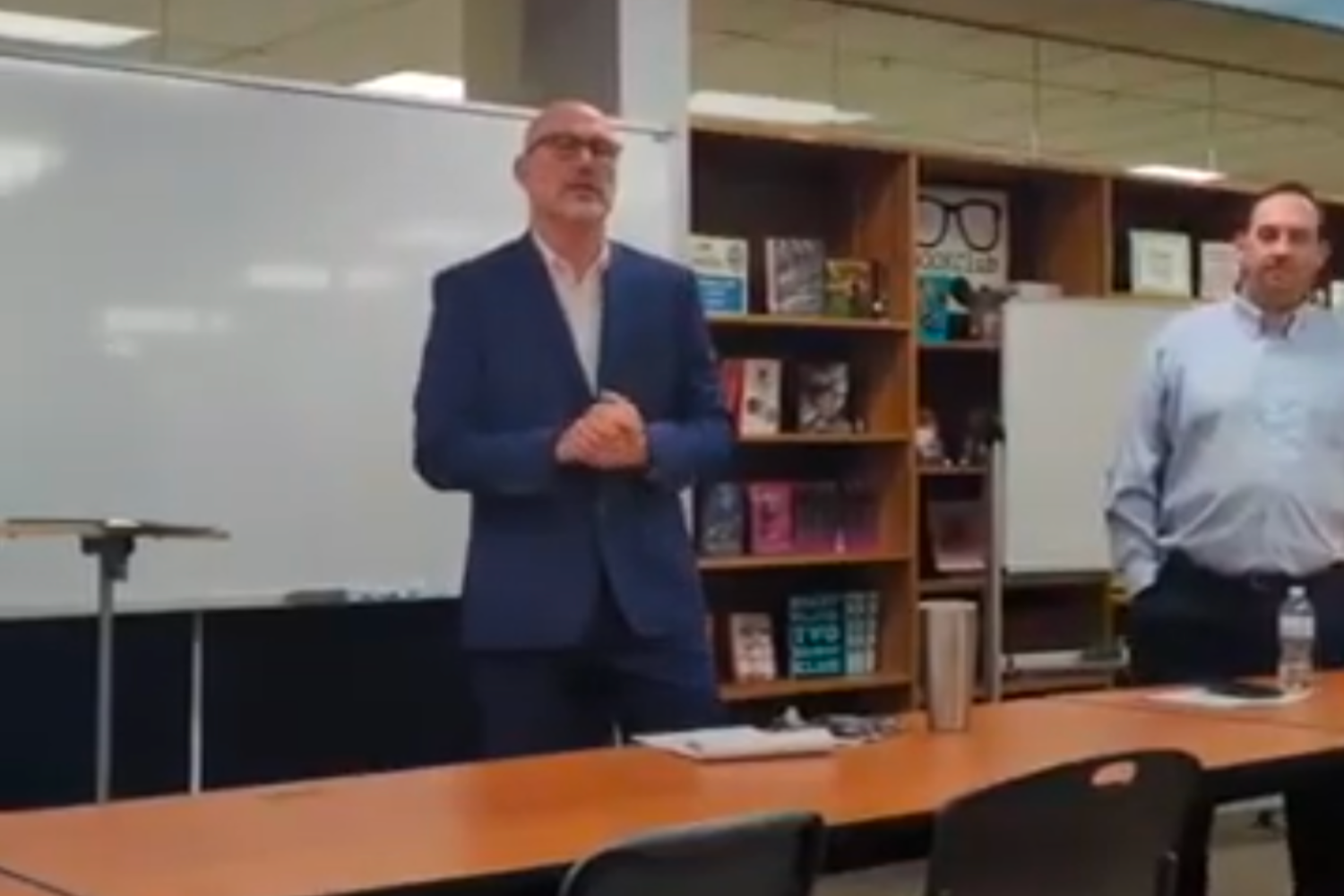
Vermilion — The high school library was well attended Wednesday evening as Superintendent Wes Weaver and Treasurer Justin Klingshirn presented details of a proposed $47 million bond levy and answered questions from residents. The discussion, which lasted nearly two hours, gave both district leaders and community members a chance to explain their reasoning and concerns about Vermilion’s aging school buildings and the cost of keeping them safe and functional.
Weaver began by introducing himself and explaining why the meeting was called. He said the district wanted to present the full picture before voters head to the polls. “This is not a campaign event,” he told the crowd. “This is about information. Our goal is to make sure everyone understands what is being proposed and why.” Weaver, who stepped into the superintendent role less than a month ago, said he knew he was walking into a conversation that had been building for years. “These facilities have served this community well,” he said, “but they are showing their age.”
A look at the facilities
Weaver described the condition of the district’s three main campuses. Vermilion High School, built in 1968, has three layers of roofing, including an asbestos base layer that must be removed and replaced at an estimated cost of between four and seven million dollars. The building also needs new water mains, updated electrical service, and a complete HVAC overhaul. The middle school, nearly fifty years old, has a deteriorating curtain wall that leaks during heavy rain, along with outdated systems that no longer meet modern safety standards. The bus garage, dating back to around 1948, is one of the oldest school facilities in the county and would be rebuilt entirely for roughly two and a half million dollars. The tennis courts are also due for reconstruction at a cost of about 1.1 million dollars. Weaver said those four projects alone total nearly eleven million dollars before addressing the remaining needs in other areas. “The costs sound big because the problems are big,” he said.
He emphasized that the proposal is not about adding amenities or expansion but about preventing costly emergencies later. “We are trying to fix what keeps the buildings safe, dry, and operational,” Weaver said. He also told residents that if the bond fails, the district will continue to operate and maintain the schools as best it can, but repairs will come more slowly and at higher cost over time.
Financial background and presentation
After the introduction, Treasurer Justin Klingshirn took the floor to walk through the financial details. His presentation covered the bond structure, Vermilion’s borrowing limits, and how the district reached this point. Klingshirn explained that the district has no permanent improvement levy, meaning there is no dedicated fund for capital work. All maintenance and repair costs come out of the general fund, which also pays salaries, classroom supplies, and daily operations. “The general fund was never meant to cover major construction,” he said. “It creates a situation where we either spend on facilities or spend on programs, and we can’t do both forever.”
He noted that a previous attempt to establish a permanent improvement levy failed in the 1990s, and when the last bond was rejected, the district turned to Certificates of Participation to finance projects such as the elementary school, fieldhouse, and band room. Those payments will continue through 2037 at a cost of about 1.2 million dollars per year. In 2022, the district used federal COVID reimbursements to create a two-million-dollar capital fund. That money went toward a new middle school roof and HVAC replacement. Earlier this year, the board allocated an additional 7.6 million dollars for capital improvements, which will be used regardless of whether the new bond passes. Klingshirn said those funds were critical but would not be enough to handle all the district’s needs. “We can’t roof the high school, fix the bus garage, and handle the middle school at the same time with that amount,” he said.
Audience questions during the presentation
As Klingshirn went through slides showing cost breakdowns, several audience members began asking questions. One asked why the district could not handle repairs in smaller phases rather than pursuing a bond. Klingshirn said the scope of the work makes that impractical. “Replacing a roof that size is not something we can break into parts,” he said. “Once asbestos removal starts, the project must be completed in one continuous phase.”
Another asked whether the district had explored state or federal grants before turning to taxpayers. Klingshirn said the district routinely applies for safety and transportation grants, but construction grants are rare. “If we do get one, it would go directly toward reducing what we have to borrow,” he said. He added that the district intends to apply for a USTA grant to help offset the cost of rebuilding the tennis courts.
One resident questioned whether a new high school might be a better long-term investment than continuing to repair one that is more than fifty years old. Klingshirn explained that the district’s legal borrowing limit makes that impossible. “A new high school would cost around fifty-three million dollars,” he said. “By law, we cannot borrow that much, even if we wanted to.” He said the proposed bond represents the maximum the district can responsibly pursue while still maintaining its current programs.
Understanding taxes and funding limits
Klingshirn spent part of his presentation explaining how state and county tax changes affect local school finances. Vermilion currently sits at the state’s twenty-mill floor, a baseline property tax rate intended to stabilize school funding. In 2026, that floor will be lifted, lowering local school taxes by about 3.1 mills but also reducing district revenue by roughly 2.5 to 2.9 million dollars each year. He said the county rollbacks will also cost the district money. Erie County’s temporary doubling of homestead and owner-occupied credits will reduce revenue by about 315,000 dollars, while Lorain County’s version will cut another 185,000 dollars. “The state reimburses mandatory rollbacks,” Klingshirn said. “The counties’ extra credits come directly out of our revenue.”
He also explained that Vermilion spends about 16,000 to 16,600 dollars per student each year but receives only about 3,000 dollars per student from the state. “The formula makes us look like a wealthy district because of property values, but we are not,” he said. “We’re small, and our tax base cannot carry these capital needs without outside support.” Klingshirn also clarified that state lottery funds go into the general state budget and do not directly benefit local districts.
View the presentationThe public Q and A
After Klingshirn concluded his formal presentation, Weaver opened the floor for questions. Residents spoke freely, some reading from prepared notes. A few asked for more detailed breakdowns of how each project cost was determined. Klingshirn said he would release the full project list with estimates and post it on the district website. One resident asked for assurances that local contractors would have opportunities to bid on the work. Weaver said all contracts will be bid publicly under state law and that Vermilion-area firms are encouraged to apply.
Concerns about affordability dominated the Q and A. Several residents said they understand the need for repairs but worry about another tax increase. “It’s not that we don’t value education,” one woman said. “We just have to live within our means, and everything costs more this year.” Klingshirn acknowledged that reality. “We know people are stretched,” he said. “We are too. But if we delay major repairs, they will become emergency repairs, and those always cost more.”
Others asked how the district could ensure this does not happen again in twenty years. Weaver said part of the long-term plan is to continue setting aside funds for capital work each year. “If this passes, we will keep building a reserve,” he said. “That is how we make sure future boards are not in the same position.”
One person asked what would happen if the bond fails. Weaver said the district will continue operating all schools and maintaining safety with the funds it has. Klingshirn said the 7.6 million dollars already reserved will go first to replace the high school roof, with the remainder used for water and mechanical repairs. “We will keep moving forward,” he said, “but without the bond, progress will be slower.”
Open discussion and meeting end
The discussion remained civil and detailed throughout, with Weaver and Klingshirn taking turns responding to questions. Attendance was steady, with dozens of residents listening closely and occasionally challenging the presenters on specific numbers. Some thanked the officials for the transparency and said the information helped them understand the district’s financial position better. Others remained skeptical that Vermilion households can absorb another long-term tax. “We just got hit with higher water bills and property values,” one resident said as the meeting closed. “It’s hard to look at another increase and say yes.”
Weaver ended the session by thanking everyone who attended and promising continued openness. “This is not the last conversation,” he said. “Whether people support the bond or not, I want them to feel informed and heard.” He said the district plans to post meeting materials and follow-up documents online so residents can review the data on their own time.
If the bond is approved, the district plans to issue bonds this winter, open construction bids in early 2026, and begin work by summer. Projects would be scheduled in phases to minimize classroom disruption. If it fails, the district will continue relying on the existing capital fund to address the most urgent needs. Klingshirn said he hopes residents will weigh both the cost and the long-term risk of continued delays. “The need is not going away,” he said. “The question is how we choose to pay for it.”
The meeting ended quietly. No vote was taken, but the conversation left a clear impression that the community is paying attention. Both sides, supporters and skeptics alike, agreed on one point as they left the library: the schools need work, and Vermilion’s next decision will determine how that happens.
About the Author