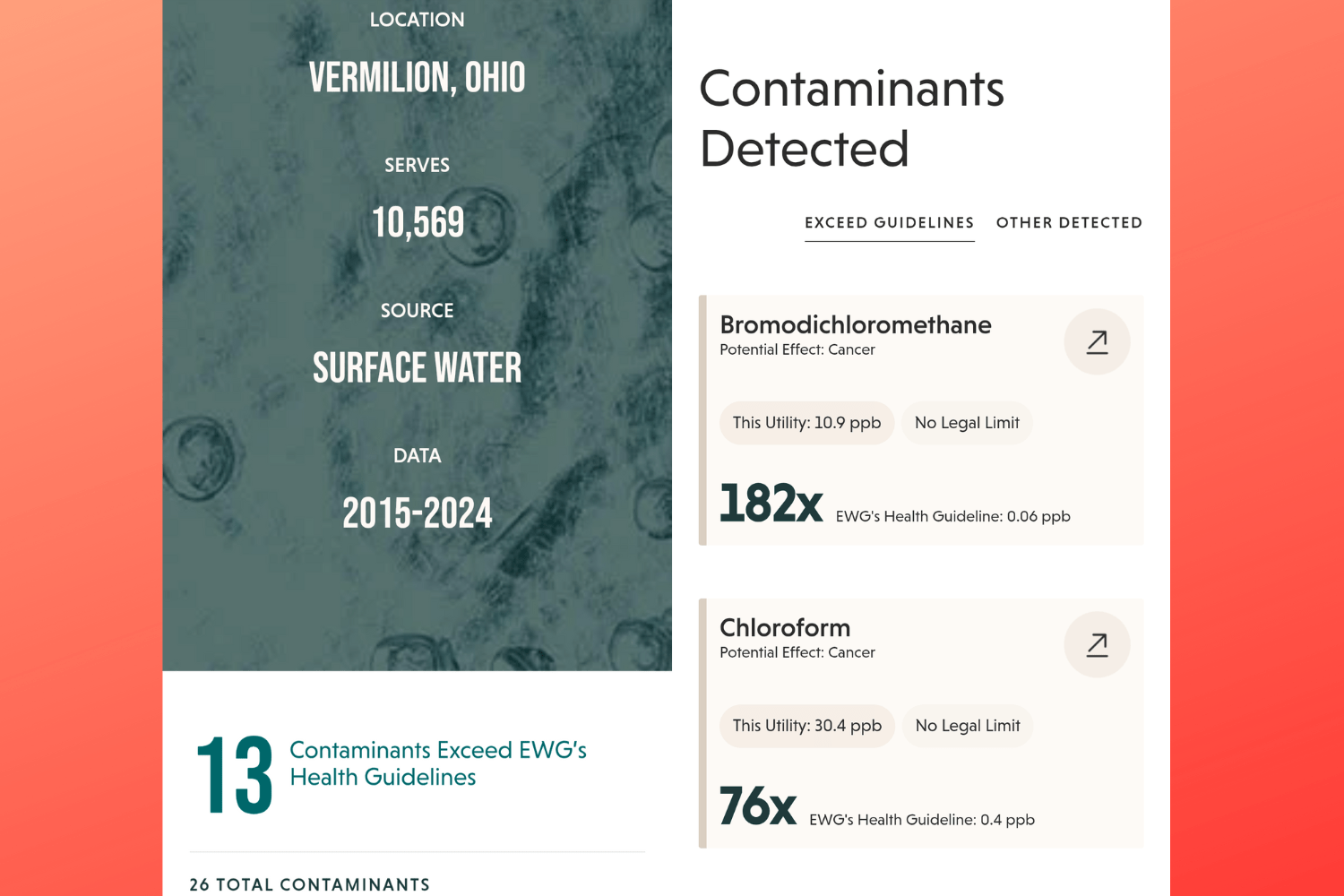
A national analysis by Newsweek is raising concerns about drinking water contamination across the U.S., and Ohio ranks among the states with the most flagged systems. While Vermilion’s public water supply currently meets all legal safety standards, an independent health organization says residents may still have reason to be cautious.
📰 Read the full Newsweek report here
What’s in Vermilion’s Water?
According to the City of Vermilion’s 2022 Consumer Confidence Report, the city draws its water from Lake Erie, with emergency backup from the Vermilion River and interconnections with Lorain and Erie County systems. The report confirms that no Ohio EPA violations were found, and all mandatory testing was completed.
However, a separate report from the Environmental Working Group (EWG) shows that Vermilion’s water contains bromodichloromethane, a chemical byproduct of the chlorination process used to disinfect drinking water. While not illegal, the amount detected—10.9 parts per billion (ppb)—is more than 180 times higher than EWG’s strict health guideline of 0.06 ppb.
Nearby areas such as the Erie County Vermilion District tested even higher, at 13.1 ppb.
Health Risks: Legally Safe, But Scientifically Concerning?
The EPA does not currently require action at these levels, but the EWG warns that long-term exposure to bromodichloromethane may increase cancer risk and cause reproductive harm. The discrepancy highlights a key difference: legal compliance does not always equal health safety, particularly for vulnerable populations like pregnant women or children.
The Ohio EPA has also noted that surface water sources like Lake Erie are highly susceptible to contamination from runoff, industrial discharge, boating activity, and other pollution sources, especially in urban and agricultural regions.
What Can You Do? Filter Options That Help
If you’re concerned about long-term exposure to disinfection byproducts, home water filters can help reduce risk. Look for models certified under NSF/ANSI Standard 53 or 58, which are tested for contaminant reduction, including trihalomethanes (TTHMs).
Recommended filter types include:
- Pitcher Filters – Brands like ZeroWater and Clearly Filtered target chlorine byproducts, though effectiveness varies.
- Faucet-Mounted Filters – PUR and Culligan offer easy-to-install systems that reduce multiple contaminants.
- Under-Sink Reverse Osmosis (RO) Systems – High-end filters like iSpring or APEC provide multi-stage protection.
- Whole-House Filtration – Aquasana or Pelican systems offer full-home coverage but require installation and maintenance.
Tip: Always verify certifications and replace filters on schedule. An expired or low-quality filter can worsen water quality.
Bottom Line
Vermilion’s water is considered safe by EPA and Ohio EPA standards, but independent health data urges caution. While the levels of chemicals like bromodichloromethane do not violate any laws, they may exceed what some scientists consider truly safe for long-term health.
For residents who want extra peace of mind, adding a certified water filter and staying engaged with local water quality reports may be the best next steps.
For more details on Vermilion’s specific water test results, you can view the Environmental Working Group’s full analysis of the city’s water system by visiting their Vermilion Water Quality Report.
About the Author