Citizens must defend rights and resources

Freedom isn’t free.
I heard that from my elders when I was a young man and thought it sounded a little dramatic.
Thirty years later, I no longer do. I understand why those elders insisted that freedom must be defended.
Many were World War II veterans who had seen parts of the world descend into tyranny. They witnessed what happened when people were overpowered and their rights were trampled.
That does not mean every disagreement with government is tyranny. It means free people cannot assume their rights and institutions will defend themselves.
Citizens cannot wait until cameras are installed, zoning maps are redrawn, utilities are committed or regional agreements are signed.
By then, residents may be told the decision has already been made, the deadline has passed or the proper procedure was followed.
Government is supposed to work for the people. That only happens when people are watching.
Voting every few years is important, but citizenship cannot begin and end at the ballot box. Accountability also requires attending meetings, reading agendas, asking questions, requesting public records, sharing verified information and organizing with neighbors.
Those actions are becoming increasingly important as governments, corporations and regional institutions seek access to local land, water, electricity, tax revenue, personal information and decision-making authority.
The issue is not that every government program, development proposal or new technology is automatically bad. The issue is whether residents receive complete information and exercise meaningful control before permanent decisions are made.
When procedure causes confusion
Recent City Council action in Vermilion illustrates why residents need to understand exactly what each vote decides.
Council was asked to accelerate participation in Lorain County’s proposed Urban County Community Development Block Grant program because the county faced an approaching federal deadline.
Council voted 5-1 against suspending its normal three-reading process, with one member abstaining.
That vote did not defeat the resolution itself. It meant the measure would continue through the ordinary reading process. Still, the discussion showed that several members had serious reservations, and people in the audience could reasonably have left believing the proposal had effectively been rejected.
Council later received additional information and returned to the issue during a special meeting. There is nothing inherently improper about continuing consideration of a resolution that remained pending, particularly after officials received information they previously requested.
The lesson is not that council acted unlawfully. It is that procedural distinctions must be explained clearly.
Residents should know whether officials are voting on final passage, suspending the rules, reconsidering an earlier decision or simply advancing a measure to another reading.
When residents and officials leave the same meeting with different understandings of what occurred, public trust suffers. That is precisely when citizens must remain involved and follow the process through its conclusion.
A more contentious disagreement is now emerging in Vermilion-area Brownhelm Township.
First Vermilion, now Brownhelm Township
Elisabeth Corrigan, a member of the Facebook group Voices of Brownhelm Township, said in a post to the group that the township’s Land Use Steering Committee voted in July to keep its proposed future land-use map largely consistent with Brownhelm’s current rural zoning, except for a small parcel north of state Route 2.
Corrigan said committee members understood that an official vote had occurred and proceeded to the next portion of the plan. She said Trustee Dan DePalma subsequently characterized the decision as a “straw vote” and requested that the committee reconsider potential land-use changes along Baumhart Road.
In a comment beneath Corrigan’s post, Cody Northeim, who said he serves on the steering committee, also disputed the “straw vote” characterization.
Northeim wrote that the vote was clear and understood by everyone, including DePalma. He also claimed DePalma had discussed persuading committee members to consider using Brownhelm Township land for development being pursued by county commissioners.
That is a firsthand account, but it is not yet an established official finding. The meeting record and those who participated must clarify what occurred. DePalma also should have an opportunity to explain his position and respond to Northeim’s account.
Brownhelm’s trustees, including DePalma, separately stated in May that data centers are neither wanted nor welcome in the township. Northeim’s comment should not be treated as proof that the land-use disagreement involves data centers or is connected to Vermilion’s separate Urban County proposal.
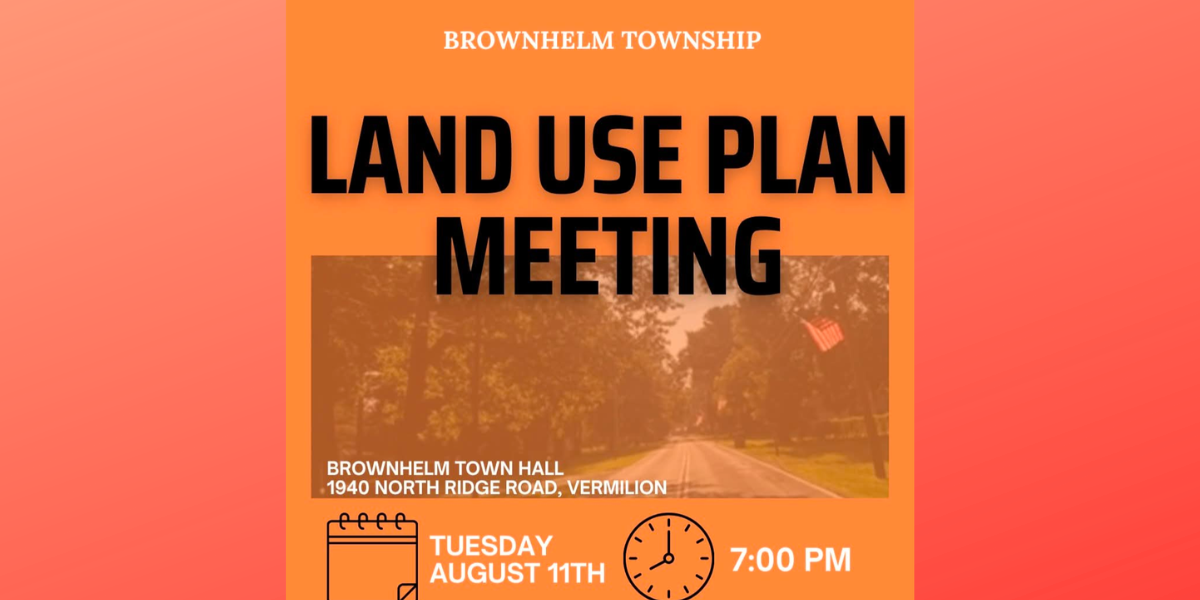
The committee is scheduled to meet again at 7 p.m. Aug. 11 at Brownhelm Township Hall.
Several basic questions require answers.
Was the July vote identified as informal before it occurred, or was it called a straw vote only after the result was known? Was there a formal motion? What was the vote count? What new information justifies reopening the decision? What specific land-use changes are being considered along Baumhart Road, and who requested them?
Those questions deserve answers before final conclusions are reached.
The public response in Brownhelm also demonstrates what citizen organizing can accomplish. Residents describe people of different generations, political affiliations and backgrounds working together not only to oppose industrial development, but also to propose growth that preserves the township’s rural character.
The dispute itself demonstrates why residents must attend. If nobody is present to hear how a motion is described before a vote, the public may later be left arguing about what the vote meant.
Reconsideration is not inherently wrong. New evidence can justify another discussion or vote. But relabeling a decision after seeing the result, obscuring its procedural meaning or repeatedly voting until officials obtain their preferred outcome is different.
Officials who manipulate procedure to keep revisiting decided issues should expect voters to remember.
Public office is not permanent ownership of power. When representatives stop respecting the people’s voice, citizens have a peaceful and decisive remedy: Vote them out and replace them with officials who will.
Resources include more than land
When people hear the word “resources,” they often think about land, water, electricity or money. Those resources matter, particularly as data centers and other large developments seek locations in rural and suburban communities.
A proposed development may bring investment and jobs, but residents should still ask what it will consume.
How much electricity will it require? Will new infrastructure costs fall on taxpayers or ratepayers? How much water will it use? Will it receive tax incentives? Who pays for roads, emergency services and other long-term demands? What happens if the original promises are not fulfilled?
Asking those questions is not anti-development. It is responsible citizenship.
Privacy and constitutional rights are also community resources.
Flock Safety automated license plate readers are often presented as tools to help police identify stolen vehicles or locate wanted suspects. But the cameras scan vehicles belonging to ordinary people who are not suspected of crimes.
Residents have the right to ask how long that information is retained, who can search it, which agencies can receive it, how misuse is detected and whether surveillance will expand after the system is installed.
Asking those questions is not anti-police. It is constitutional due diligence.
Communities should not become testing grounds where government and private companies determine how far surveillance can expand before citizens object.
If people treat their freedoms and rights as permissions they must request from government, they do not truly have them.
Rights are not favors granted by officeholders. They are boundaries government must respect.
That does not eliminate lawful restrictions or personal responsibility. It means government carries the burden of justifying an intrusion rather than citizens carrying the burden of explaining why they deserve freedom.
Accountability requires participation
Rural and suburban communities are vulnerable when meetings are sparsely attended and important decisions receive little public attention.
Major proposals can move through committees, special meetings and procedural votes before most residents realize anything is happening. By the time public opposition forms, officials may argue that too much time or money has already been invested to turn back.
That is why residents must become involved early.
Attend meetings before the final vote. Read agendas and supporting documents. Ask officials to identify guarantees in writing. Request contracts, studies and correspondence. Record exact motions and vote counts. Share verified information on social media. Organize with neighbors. Track how representatives vote, and return later to determine whether their promises were kept.
Social media can be a powerful accountability tool, but it must be used responsibly. Facts are more persuasive than rumors. Documents are stronger than accusations. Direct quotations are harder to dismiss than assumptions about motives.
Citizens should remain civil, but civility does not require silence. Respect does not require submission. Asking difficult questions is not harassment, and organized opposition is not extremism.
Government power grows most easily when citizens become convinced that resistance is pointless.
It is not pointless.
A crowded meeting changes the atmosphere. A public-records request creates documentation. A group of residents asking the same unanswered question becomes harder to ignore. An organized voting bloc can remove officials who stopped listening.
Rights and local control rarely disappear through one dramatic decision. They are weakened through smaller choices made when few people are watching.
If officials begin treating “no” as an invitation to keep pushing, citizens must show them that votes and public opposition still carry consequences.
Show up. Ask questions. Share facts. Organize. Vote.
Government belongs to the people only as long as the people insist that it does.